 ultimate-guide
Is Solid Wood Furniture Worth It? A 2026 Buyer's Guide
Table of Contents
- The Real Cost of Solid Wood Furniture vs. Particle Board
- How to Identify Solid Wood Furniture Before You Buy
- Solid Wood Furniture Maintenance Tips for a Lifetime of Use
- Climate, Humidity, and How Wood Behaves in Your Home
- Wood Species Comparison: Oak, Maple, Cherry, and Walnut
- Lifecycle Cost Analysis: What You Actually Spend Over 20 Years
- Resale Value and Heirloom Quality: Does Solid Wood Hold Up?
- Conclusion
- Frequently Asked Questions
Last Updated: October 2, 2026
The Real Cost of Solid Wood Furniture vs. Particle Board
Solid wood furniture is worth it when you plan to keep a piece for years rather than replace it every few seasons. It costs more upfront, the question is what you get for that difference over time. The answer depends on how you use the piece, how long you intend to keep it, and whether you value repairability over a lower sticker price.
Upfront Price vs. Long-Term Value
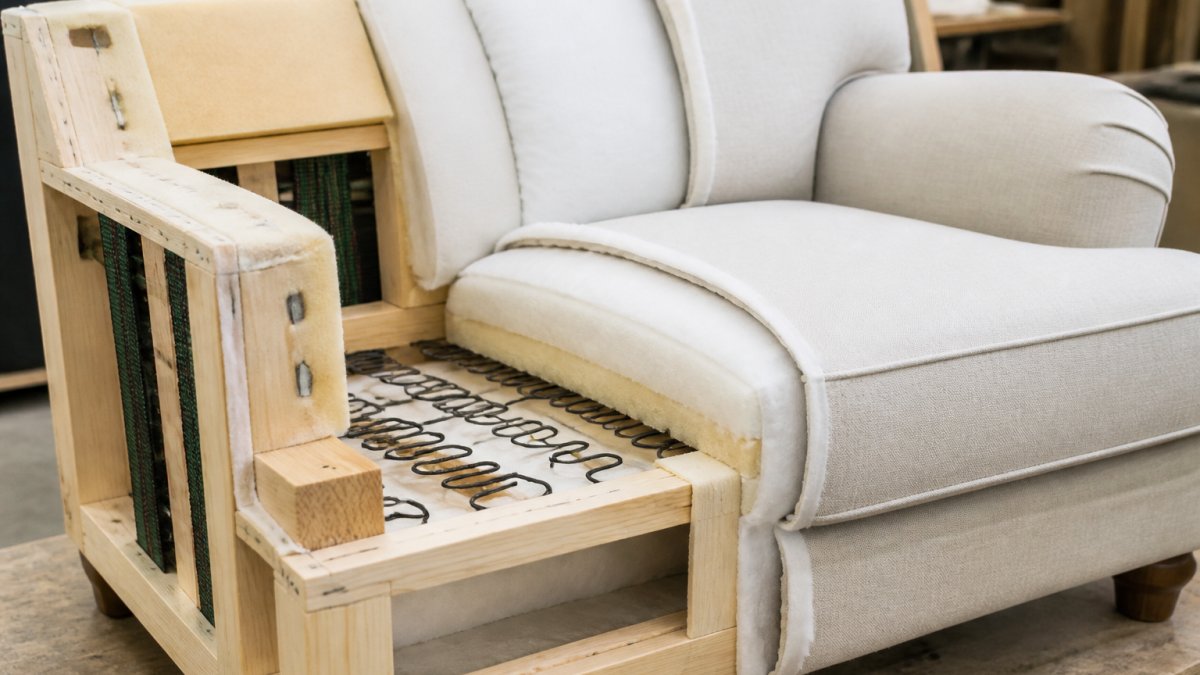
Particle board and MDF furniture win on day one. They cost less because the material is cheaper to produce: wood fibers and resin pressed into panels, then wrapped in a printed veneer or laminate. Solid wood costs more because a tree grows for decades before it becomes a table.
Durability and Repairability
Here's where the two categories stop being comparable. Particle board cannot be sanded, re-glued at a broken joint, or re-shaped, once the resin bond fails or water swells the core, the piece is finished. Solid wood responds to repair the way wood always has: sand it, stain it, re-glue the joint, and it returns to service.
How to Identify Solid Wood Furniture Before You Buy
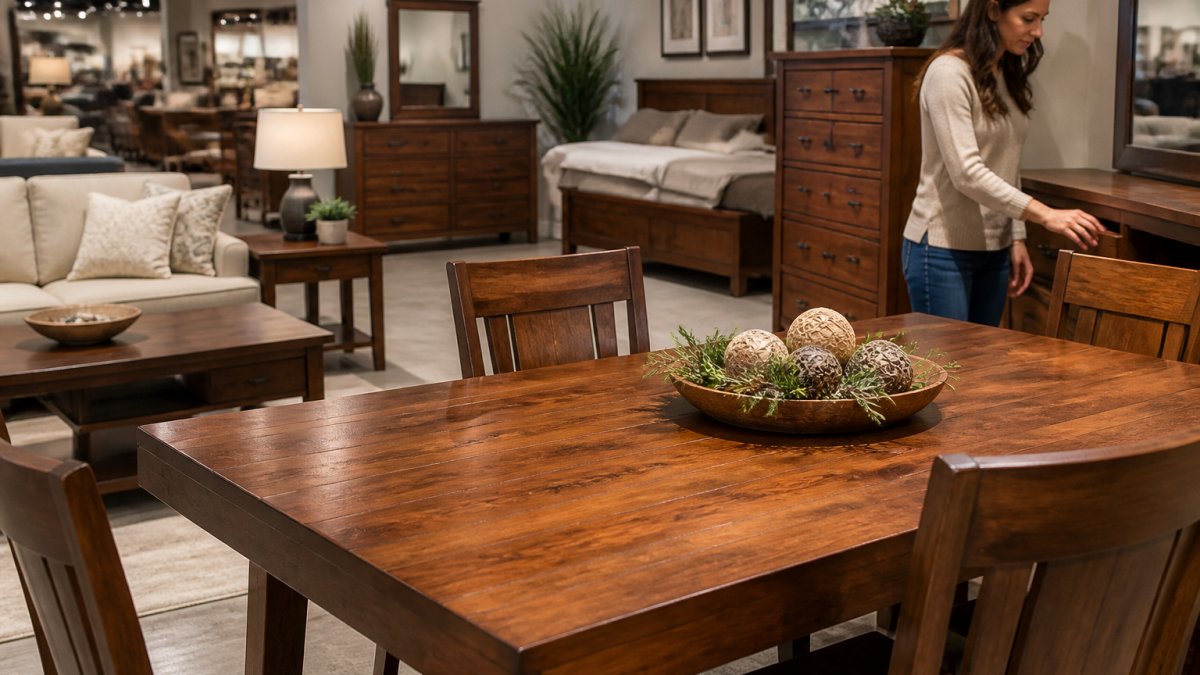
Most guides tell you to 'check the grain and feel the weight,' which is useless in a showroom with a salesperson beside you. What you need is a short, repeatable sequence of non-destructive checks you can run in under two minutes without tools or relying on the label.
The Two-Minute Showroom Test
Run these in order. If a piece fails the first two, stop, you already have your answer.
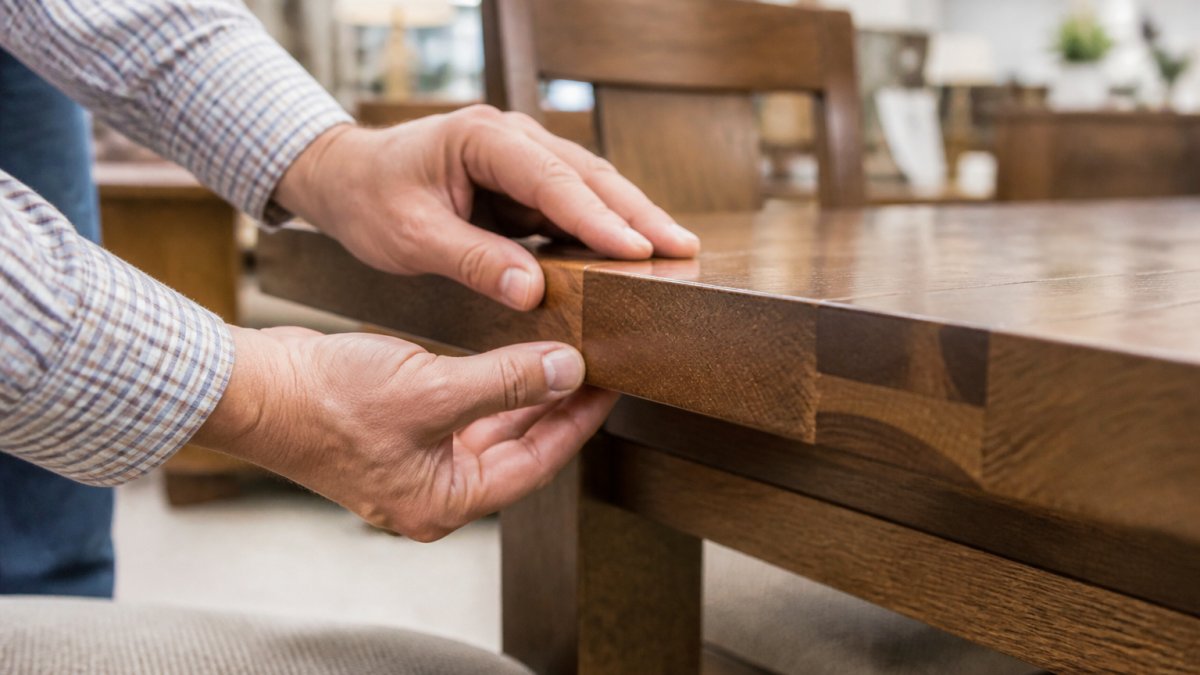
- Look at the end grain on an exposed edge. On a tabletop, that's the narrow strip along the short side. Solid wood shows grain lines continuing through the full thickness of the board, like a stack of pages viewed from the side. Veneer shows a thin top layer over a different core, and the edge grain won't match the face.
- Compare the top grain to the side grain at a corner. On a solid wood top, face and edge grain are the same board, so the lines flow around the corner. On veneer, the face pattern is often mirrored or repeated, a telltale sign of sliced veneer.
- Check the underside. Flip a chair or lift a small table. Makers who use solid wood throughout aren't shy about the underside. A smooth, uniform panel with no grain variation means a solid-wood top on an engineered carcass.
- Open a drawer and look at the sides and back. Solid wood drawer sides show grain and slight thickness variation; particle board sides have a uniform, speckled core visible at the top edge where the finish stops.
- Press a fingernail into an inconspicuous spot. Solid wood gives slightly under resistance; a laminate over particle board feels hard and hollow, and the nail slides rather than bites.
Reading the Label Without Getting Fooled
The phrase 'solid wood' is not regulated the way 'organic' is. A piece can be labeled 'solid wood' and still use solid wood only on the top and drawer fronts, with plywood or particle board underneath. The Federal Trade Commission's guidance on 'all wood' and 'solid wood' claims requires them to be truthful and not misleading, but enforcement is complaint-driven, so the burden is on you to verify.
What to ask, word for word:
- 'Which parts of this piece are solid wood, and which are not?'
- 'Is the case, the drawer boxes, and the back panel solid wood, or just the top and fronts?'
- 'What species is the solid wood, and is any part of it a veneer over solid wood?'
Joinery: The Structural Tell
- Dovetail or box joints on drawer boxes, interlocking cuts that resist pulling apart.
- Mortise-and-tenon joints at table aprons and chair legs, a tenon fitted into a mortise and pinned or glued.
- Corner blocks screwed or glued into inside corners of case goods to keep the frame square.
What 'Solid Wood' Does Not Guarantee
Solid wood is a construction fact, not a quality grade. A piece can be solid wood and still be poorly built: thin stock, weak joinery, a finish that won't hold up. The reverse is also true, a well-built piece with a plywood core and quality veneer can outlast a cheap solid wood piece. Use the checks above to confirm what you're buying, then judge build quality separately.
Solid Wood Furniture Maintenance Tips for a Lifetime of Use
Basic solid wood furniture maintenance comes down to four habits: keep it out of direct sun, control indoor humidity, dust with a soft cloth, and address spills immediately. Together they add decades to a piece's life.
- Dust weekly with a dry microfiber cloth rather than a wet rag
- Use coasters and felt pads under lamps, vases, and hot dishes
- Wipe spills with a damp cloth and dry the surface right away
- Apply a furniture wax or oil finish once or twice a year
- Keep the piece at least a few inches from heating vents and radiators
Climate, Humidity, and How Wood Behaves in Your Home
Wood moves. That's not a defect; it's the nature of the material. Solid wood absorbs and releases moisture with the seasons, expanding in humid summer air and contracting when winter heating dries things out. That's why moisture content matters at purchase, and why a piece built and stored in a humid climate can crack if suddenly moved into a dry, heated home.
- Keep indoor relative humidity roughly between 35% and 55% if you can
- Avoid placing furniture directly over floor vents
- Let new pieces acclimate in the room for a few days before loading them
- Use a humidifier in winter if your home gets very dry
Wood Species Comparison: Oak, Maple, Cherry, and Walnut
Each species brings a different combination of hardness, grain, color, and price. The right choice depends on how hard the piece will be used and what look you want.
| Species | Hardness | Grain Character | Color Shift Over Time | Best For |
|---|---|---|---|---|
| Oak | Very hard | Bold, open grain | Light ambering | Dining tables, daily-use pieces |
| Maple | Very hard | Fine, subtle grain | Minimal change | Bedroom sets, clean modern looks |
| Cherry | Medium | Smooth, tight grain | Darkens to deep red-brown | Formal dining, heirloom pieces |
| Walnut | Medium-hard | Rich, flowing grain | Slight lightening | Statement pieces, living rooms |
Lifecycle Cost Analysis: What You Actually Spend Over 20 Years
Most articles say solid wood 'pays for itself over time' and leave it there, not a number you can act on. Here's how to run the math for your own situation, using a dining table as the example.
The Framework
Lifecycle cost has four parts:
- Purchase price, what you pay on day one.
- Replacement cost, how many times you buy the piece over the period you are measuring.
- Maintenance and repair cost, refinishing, re-gluing, hardware replacement.
- Residual value, what the piece is worth at the end, either as resale or as a handoff to someone else.
The formula is simple: (Purchase + Replacements + Maintenance − Residual) ÷ Years of use = cost per year.
A Worked Example
Assume a 20-year horizon and a dining table you use daily.
The Variables That Flip the Answer
Lifecycle math isn't universal. These levers change the result:
- How hard the piece is used. A formal dining room table used a few times a year behaves very differently from a kitchen table used three times a day.
- Household composition. Kids, pets, and frequent moves shorten the life of engineered furniture far more than solid wood.
- Climate and humidity control. In a home with wide seasonal humidity swings and no humidity control, engineered cores fail faster, which widens the solid wood advantage. In a stable, climate-controlled home, engineered furniture lasts longer than the worst-case scenario.
- How long you actually stay. If you move every two years and buy furniture to fit each place, the lifecycle case for solid wood weakens, you may not stay long enough to realize it.
- Whether you refinish or replace. A solid wood piece that gets refinished at year 12 is a very different cost profile from one that gets replaced at year 12 because the owner did not want to deal with it.
The Break-Even Question
The useful way to frame this is not 'is solid wood cheaper?' but 'how many years do I need to keep this piece for the solid wood option to win?' Run the four-part formula with your own numbers. If the answer is shorter than how long you realistically expect to keep the piece, solid wood is the better financial decision.
What This Means for Resale and Handoff
The residual value line is where solid wood separates most sharply. A solid wood piece with classic lines and real joinery retains value because the next buyer can refinish it, repair it, and keep using it. That residual value isn't guaranteed, it depends on the piece, market, and condition, but it's a real number most buyers forget to include.
Resale Value and Heirloom Quality: Does Solid Wood Hold Up?
Solid wood holds resale value in a way engineered furniture cannot. A well-made solid wood piece with classic lines still finds buyers decades later, whether through a consignment shop, an estate sale, or a family handoff. Particle board furniture has essentially no resale market once assembled and used.
Conclusion
Choosing furniture is a long-term decision, and the pressure to get it right is real. Cannon's Fine Home Furnishings carries solid wood bedroom sets, dining tables, and living room pieces from trusted brands like Bassett, England, and Vaughn-Bassett, all in a 70,000-square-foot showroom where you can open drawers, check the joinery, and compare materials side by side.
Frequently Asked Questions
What are the disadvantages of solid wood furniture?
Solid wood can be heavier and more expensive upfront than particle board or MDF. It also reacts to humidity changes, expanding and contracting, which can cause minor cracks if not maintained. Some pieces require periodic oiling or polishing. However, these drawbacks are often offset by longevity and repairability.
How can you tell if furniture is real solid wood or veneer?
Check the edges: solid wood shows continuous grain that wraps around, while veneer has a distinct edge where the thin layer meets the core. Look at the underside and back panels; solid wood will have matching grain patterns. Also, solid wood feels heavier and sounds denser when tapped. Ask the retailer for construction details.
Is solid wood furniture worth the higher price point?
For many buyers, yes. Solid wood pieces can last decades and often be refinished, while particle board may need replacing within 5-10 years. The higher upfront cost spreads over a longer life, and some styles retain resale value. Consider your budget and how long you plan to keep the piece.
Does solid wood furniture hold its value over time?
Quality solid wood furniture from reputable brands can retain or even increase in value, especially if it's a classic design or made from sought-after species like cherry or walnut. However, resale depends on condition, style, and market demand. Proper care and documentation help maintain value.
What are the best ways to maintain solid wood furniture?
Dust regularly with a soft cloth, avoid direct sunlight and extreme humidity, and use coasters for drinks. Clean with a slightly damp cloth and mild soap, then dry immediately. Every 6-12 months, apply a furniture polish or oil designed for the finish. Address scratches promptly with a touch-up marker or wax stick.
Is oak furniture considered outdated in modern interior design?
No, oak remains a popular choice for its durability and timeless grain. While heavy orange-toned oak from the 1980s may feel dated, modern finishes like white oak or cerused oak are trending in contemporary interiors. Oak works well in both traditional and modern settings.