 ultimate-guide
How to Spot Quality Sofa Construction
Table of Contents
- How to Assess Overall Sofa Quality
- Best Sofa Frame Materials and Construction
- Sofa Suspension Types and Spring Systems
- Sofa Cushion Fill Types and Foam Density
- Upholstery Quality and Seam Integrity
- Sofa Construction Checklist for In-Store Inspection
- Step 1: Assess Frame Rigidity and Movement
- Step 2: Inspect the Underside and Interior
- Step 3: Test Spring and Suspension Response
- Step 4: Evaluate Cushion Compression and Rebound
- Step 5: Inspect Seams and Stitching
- Step 6: Feel the Upholstery Material
- Quick Reference: Red Flags to Avoid
- What to Ask the Retailer
- Warranty, Durability, and Repairability
- Frequently Asked Questions
Last Updated: October 11, 2026
How to Assess Overall Sofa Quality
Quality sofa construction separates a piece lasting a decade from one failing in three years. Most buyers focus on appearance and comfort, but longevity depends on what's hidden: the frame, suspension system, cushion materials, and joinery. At Cannon's Fine Home Furnishings, we help customers evaluate sofas by examining the engineering underneath the upholstery.
Best Sofa Frame Materials and Construction
The frame is the skeleton of any sofa. A quality frame uses kiln-dried hardwood, specially dried to prevent warping. Engineered wood, particleboard, and softwood are cheaper but lack durability. Inspect for tight joinery and reinforcement at stress points. Push down on the seat, it should feel rigid without flexing or creaking.
Kiln-Dried Hardwood vs. Engineered Wood
Kiln-dried hardwood is the gold standard, heated to remove moisture, making it stable and warp-resistant. Hardwood species like oak, maple, and ash are dense and strong. Engineered wood, particleboard, and softwood are cheaper but compress under pressure or split easily, causing premature sagging and wear.
Frame Joinery: Dowels, Corner Blocks, and Fasteners
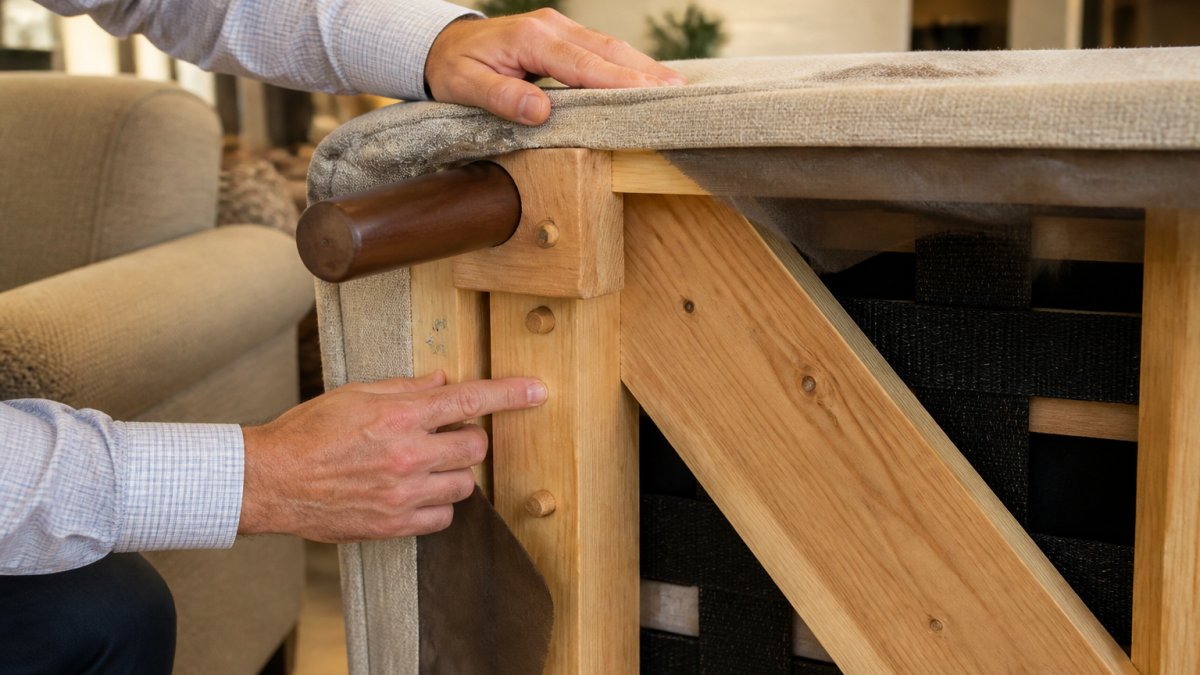
The strongest joinery combines dowels, corner blocks, screws, and glue. Dowels are wooden pegs that create mechanical locks; corner blocks reinforce joints where the frame changes direction.
Sofa Suspension Types and Spring Systems
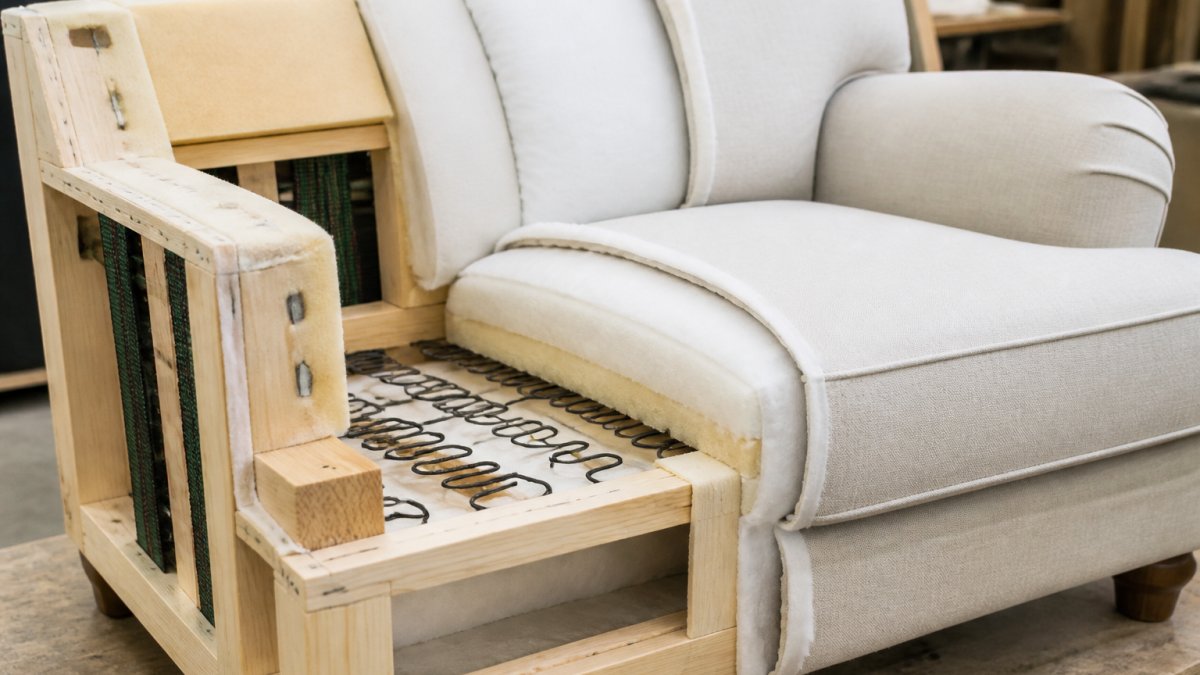
The suspension system supports your weight and absorbs impact. Eight-way hand-tied springs are premium: each spring is individually tied to the frame at eight points, creating stable, responsive support. Sinuous springs are cheaper but lack the longevity of hand-tied springs. A quality system feels supportive and maintains performance over years.
Spring Gauge, Spacing, and Eight-Way Hand-Tied Springs
Spring gauge indicates wire thickness, lower numbers mean thicker, stronger wire. A 12-gauge spring is more durable than 14-gauge. Closer spacing provides more even support. Quality springs feel firm but not jarring; the seat should not bottom out. Ask retailers for spring gauge and spacing specifications, quality manufacturers provide this readily.
Webbing and Support Systems
Webbing is a fabric strip stretched across the frame to support cushions. Quality webbing is tightly woven and securely attached at multiple frame points; cheap webbing stretches and sags. Webbing should be taut, not just at edges.
Sofa Cushion Fill Types and Foam Density
Cushion fill is often misrepresented with vague terms like "premium foam." Verify density and composition to avoid sofas that flatten quickly.
Understanding Foam Density and What It Means
Foam density is measured in pounds per cubic foot (lbs/cu ft) and directly correlates to durability and resilience. Higher density means more material, which resists compression and bounces back more consistently over time.
- Low-density foam (1.0-1.5 lbs/cu ft): Soft but compresses quickly. Expect noticeable flattening within 2-3 years of regular use.
- Medium-density foam (1.5-2.5 lbs/cu ft): Reasonable comfort and moderate durability. Holds up better than low-density foam over 5-7 years.
- High-density foam (2.5+ lbs/cu ft): Durable and resilient, resisting permanent compression. Standard in quality sofas.
How to Verify Foam Density Claims
Manufacturers often use vague marketing language. Request a spec sheet listing foam density. If a retailer cannot provide this, it's a red flag. Quality makers are transparent because density is a selling point. "Premium foam" requires specific density in lbs/cu ft; "comfort foam" is usually low-density (1.0-1.5); "support foam" should be medium to high-density; "high-density foam" should be 2.5+ lbs/cu ft.
Foam Composition and Layering
Most quality sofas use a layered foam structure: a high-density core (2.5-3.0+ lbs/cu ft) for support, optional medium-density middle layer (2.0-2.5 lbs/cu ft), and a softer comfort layer (1.0-1.5 lbs/cu ft) on top. This balances durability with comfort. Ask about layering structure, if the retailer cannot describe the layers, the foam is likely inconsistent or low-quality.
Alternative Fills: Down, Down-Blend, and Specialty Materials
Alternative fills include down and down-blend (soft but require regular fluffing and are less durable under heavy use), latex foam (more durable but significantly more expensive), and gel-infused foam (improves heat dissipation but not durability, verify base foam density separately).
Matching Foam Type to Your Household
The right cushion fill depends on how you use your sofa:
For daily lounging and heavy use: Choose high-density foam (2.8+ lbs/cu ft) with a layered structure. This will resist flattening and maintain comfort over years of regular sitting.
For formal rooms and occasional use: Medium-density foam (2.0-2.5 lbs/cu ft) is acceptable.
For households with pets or children: High-density foam is essential. Pets jump on sofas, children bounce, and accidents happen.
For comfort-first buyers: A layered structure with a high-density core and a softer comfort layer provides both durability and plush feel.
How to Test Cushion Quality in the Showroom
Press your hand firmly into a cushion and hold for 3 seconds. Quick rebound (1-2 seconds) indicates high-density foam; slow rebound (3+ seconds) suggests medium or low-density foam; no rebound indicates degraded fill. Repeat on multiple cushions, uneven rebound indicates inconsistent manufacturing.
Warranty and Replacement Considerations
Ask whether replacement cushions are available and their cost. Quality sofas typically offer 5-10 year warranties on frame and spring defects but may limit cushion coverage to 3-5 years, as some compression is normal. A sofa with replaceable, affordable cushions offers better long-term value.
Upholstery Quality and Seam Integrity
Quality upholstery fabric is tightly woven and resists pilling, fading, and staining. Seams should be straight, tight, and evenly spaced. Loose threads, puckering, or rippling indicate poor workmanship. Quality manufacturers reinforce seams at stress points with heavy-duty thread.
Sofa Construction Checklist for In-Store Inspection
Perform this hands-on evaluation in any showroom to assess construction integrity.
Step 1: Assess Frame Rigidity and Movement
Sit on the sofa normally, then shift your weight side to side and front to back. A quality frame should feel stable and immobile. Push down firmly on the seat cushion with your hand, the frame beneath should not flex noticeably or make creaking sounds.
Step 2: Inspect the Underside and Interior
Ask the retailer if you can look underneath or inside the sofa. If possible, use your phone's flashlight. Look for the following:
- Frame wood type: Identify whether the visible frame is solid hardwood (dense, uniform grain) or engineered wood (lighter color, visible particles or laminate). Hardwood is preferable.
- Joinery method: Look for wooden dowels (round pegs in holes), corner blocks (reinforcement pieces at joints), and metal brackets. Multiple methods indicate stronger construction than staples alone.
- Spring attachment: If visible, springs should be tied or secured to the frame at multiple points, not just resting on webbing. Hand-tied springs will show twine or rope running from coil to frame.
Step 3: Test Spring and Suspension Response
Sit on the sofa and bounce gently a few times. Quality springs should feel responsive and supportive without bottoming out or feeling like you're sinking into a hole. Listen for creaking or squeaking, these sounds indicate loose springs, weak webbing, or poor joinery. Press down on different areas of the seat (center, sides, corners) to check for uneven support.
Step 4: Evaluate Cushion Compression and Rebound
Press your hand firmly into a cushion and hold for 3 seconds, then release. The cushion should compress slightly and rebound quickly to its original shape within 1-2 seconds. If the cushion stays compressed or rebounds very slowly, the foam is low-density or already degraded.
Step 5: Inspect Seams and Stitching
Run your hand along all visible seams, seat edges, back, arms, and cushion borders. Seams should be straight, tight, and smooth with no puckering, rippling, or loose threads. Look closely at stress points (corners, where arms meet the frame, cushion edges). These areas should show reinforced stitching, often with a double or triple row of thread.
Step 6: Feel the Upholstery Material
Run your hand across the fabric or leather in multiple directions. Quality upholstery should feel tightly woven and smooth, not loose or pilled. Rub the fabric gently to check for pilling (small balls of fiber that form on the surface), this indicates low-quality material prone to visible wear.
Quick Reference: Red Flags to Avoid
| Issue | What It Means | Action |
|---|---|---|
| Excessive frame flex when you sit | Weak joinery or soft wood | Do not purchase |
| Creaking or squeaking sounds | Loose springs, webbing, or joints | Do not purchase |
| Cushion does not rebound within 2 seconds | Low-density foam or degraded fill | Expect rapid flattening; avoid |
| Visible gaps at frame joints | Poor joinery or assembly | Do not purchase |
| Loose or puckered seams | Poor workmanship | Seams will fail faster under use |
| Webbing is loose or sagging (if visible) | Inadequate support system | Seat will sag prematurely |
| Uneven cushion firmness across the sofa | Inconsistent manufacturing | Expect uneven wear and comfort |
| Loose threads or uneven stitching | Rushed manufacturing | Seams may separate during use |
What to Ask the Retailer
Before making a decision, ask for specific information and verify the answers:
- "What is the frame made from?" (Answer should be kiln-dried hardwood; avoid particleboard or softwood.)
- "What is the spring gauge and type?" (Lower gauge = thicker, stronger wire; 12-gauge or lower is preferable. Eight-way hand-tied is premium; sinuous springs are acceptable if well-spaced.)
- "What is the foam density?" (Should be 2.5 lbs/cu ft or higher for the seat cushion.)
Taking 10-15 minutes to perform this inspection in-store can save you thousands of dollars and years of frustration with a failing sofa.
Warranty, Durability, and Repairability
A strong warranty signals manufacturer confidence. Quality sofas typically cover frame defects, spring failure, and seam separation for 5-10 years.
Quality sofa construction depends on frame material, joinery methods, suspension system, cushion fill, and upholstery working together. At Cannon's Fine Home Furnishings, we carry brands like Bassett and England that prioritize quality construction.
Frequently Asked Questions
How can you tell if a sofa is high quality?
High-quality sofa construction combines kiln-dried hardwood frames, eight-way hand-tied or sinuous steel springs, high-density foam cushions, and reinforced joinery with corner blocks and dowels. Inspect the frame for solid wood rather than particleboard, check that springs feel firm when you sit, and look for tight, even stitching on seams. Lift the sofa to feel its weight, heavier generally indicates denser materials and better durability. Ask the manufacturer or retailer for construction specifications and warranty details to verify quality claims.
What should you look for in a sofa frame?
Look for kiln-dried hardwood frames, which resist warping and cracking better than softwood or engineered wood. Check that the frame uses corner blocks and dowels rather than staples or glue alone. Run your hand along the joints to feel for gaps or movement. Ask whether the frame is solid wood or a mix of materials. Heavier frames typically indicate better construction. Avoid particleboard or plywood frames, which break down faster. A quality frame is the foundation of a durable sofa and directly affects how long it will last.
What are the best sofa frame materials?
Kiln-dried hardwood is the gold standard for sofa frames because it's dried in a kiln to remove moisture, preventing warping and cracking. Hardwoods like oak, maple, and ash are stronger and more durable than softwoods such as pine. Engineered hardwood is acceptable as a secondary material but should not be the primary frame. Avoid particleboard and plywood, which compress under weight and fail quickly. When shopping, ask retailers about frame material and ask whether it's solid hardwood or a blend. Cannon's Fine Home Furnishings carries brands like Bassett and England that use quality hardwood frames.
How do sofa cushion fill types affect comfort and durability?
High-density foam (1.8 pounds per cubic foot or higher) resists compression and lasts longer than lower-density foam. Down and feather blends offer softness but require regular fluffing and compress over time. Memory foam conforms to your body but can retain heat. Polyester fiberfill is budget-friendly but breaks down faster. For durability, look for high-density foam cores wrapped in softer materials. Check the density rating or ask the retailer for specifications. Denser cushions feel firmer initially but maintain support longer, making them a better investment for families or heavy use.
What makes a sofa's suspension system reliable?
Eight-way hand-tied springs are the most durable suspension type, offering consistent support and longevity. Sinuous (S-shaped) steel springs are also strong and cost less than hand-tied options. Spring gauge matters, lower numbers (8-9) indicate thicker, stronger springs. Webbing should be tightly woven and evenly spaced beneath springs to distribute weight. Press down on the sofa seat and feel for firm resistance without bottoming out. A reliable suspension system prevents sagging and maintains comfort for years. Ask retailers about spring type, gauge, and reinforcement to compare options.
How can you check a sofa's springs and support in a showroom?
Sit firmly on the sofa and press down with your full weight. Quality springs should feel supportive without bottoming out. Lift the sofa or ask a salesperson to help you inspect the underside, look for visible springs or webbing that are taut and evenly spaced. Check for rust or damage on springs. Feel along the edges and corners for firm support. Bounce gently a few times to test resilience. A sofa that sags immediately or feels unstable has weak suspension. Cannon's Fine Home Furnishings staff can help you test sofas in person to find one with reliable support.
What construction trade-offs should I consider for my household?
High-density foam and hand-tied springs offer maximum durability but cost more upfront. Families with children or pets benefit from sturdy frames and stain-resistant fabrics, even at higher prices. Budget-conscious buyers might choose engineered wood frames and sinuous springs, which still provide years of use at lower cost. Lighter-use households in quiet homes can get away with softer cushions and lower-density foam. Consider your lifestyle, how many people will use the sofa, and whether you have pets. Cannon's team can help you match construction quality to your specific needs and budget.