 blog
Best Mattress Brands for Back Pain: 2026 Guide
Table of Contents
- How to Choose a Mattress for Back Pain
- Mattress Firmness for Back Pain: What Works Best
- Top Mattress Types for Back Pain Relief
- Benefits of Adjustable Bases for Back Pain
- How to Test a Mattress for Back Support
- Durability, Trial Periods, and Warranty Coverage
- Frequently Asked Questions
Last Updated: September 30, 2026
How to Choose a Mattress for Back Pain
Finding the best mattress brands for back pain starts with one question: does the mattress hold your spine in a neutral position all night? A mattress that lets your hips sink while your shoulders stay high twists the lower back for eight straight hours. That is why so many people wake up stiff and sore no matter how early they go to bed.
Spinal Alignment and Lumbar Support
Spinal alignment means your ears, shoulders, and hips stack in a straight line when you lie down. A mattress that supports this keeps your lumbar support intact instead of letting your lower back arch or flatten.
Pressure Relief and Weight Distribution
Pressure relief is how evenly a mattress spreads your body weight. Poor weight distribution creates hot spots at the hips and shoulders, which triggers tossing and turning and wakes you up.
Mattress Firmness for Back Pain: What Works Best
For most people with back pain, medium-firm is the sweet spot on the firmness scale. It keeps the spine neutral while still cushioning pressure points. That said, the right firmness depends on your weight and sleep posture.
Medium-Firm vs. Firm: Finding Your Sweet Spot
Medium-firm suits side and combination sleepers best. Firm works better for back and stomach sleepers who need to stop their hips from sinking. If a mattress feels like a board, your shoulders and hips take the beating instead of your lower back.
Weight-Specific Firmness Guide
Body weight changes everything about mattress firmness for back pain. The same bed can feel plush to one sleeper and rock-hard to another. Use this as a starting point:
| Body Weight | Best Firmness | Why |
|---|---|---|
| Under 130 lbs | Medium to medium-firm | Lighter bodies need less resistance to contour |
| 130-230 lbs | Medium-firm | Balances alignment and pressure relief |
| Over 230 lbs | Firm | Prevents sagging and keeps the spine level |
Top Mattress Types for Back Pain Relief
Three constructions dominate the market, and each one supports the back differently. The right pick comes down to how you sleep, how much you weigh, and how hot you get at night. Below is what actually changes spinal alignment in each build, not marketing language.
Memory Foam, Latex, and Hybrid Construction
Memory foam is viscoelastic polyurethane foam. It softens with body heat and slowly rebounds, which is why it contours to the shoulder and hip and why it excels at pressure relief and motion isolation. The back-pain catch is density. Foam under about 3 lb per cubic foot compresses and develops a body-shaped divot within two to three years, and that divot is what pulls the lumbar spine out of line.
- Coil count and gauge. Queen-size hybrids commonly run 700-1,000+ coils. More coils at a thinner gauge generally means better contouring; fewer, thicker coils mean a firmer, more supportive feel. A zoned coil unit, firmer coils under the lumbar, softer under the shoulders, is the single most useful back-pain feature in a hybrid.
- Transition and support foam density. The layer between the coils and the comfort foam is where cheap hybrids fail. Under 1.8 lb density and the bed develops a sag in the middle within a few years.
Temperature Regulation for Pain Relief
Heat makes pain worse. A mattress that traps body heat keeps you restless, and restlessness means more tossing and turning and less deep sleep, the stage where most tissue recovery happens. This is the angle most "best mattress" lists skip entirely: cooling is not a comfort feature, it is a pain-management feature.
What actually moves heat:
- Phase-change materials (PCMs) in the cover absorb and release heat to keep the surface near skin temperature. They work, but they fade with washing if the cover is not removable.
- Graphite and gel infusions in foam conduct heat away from the body. Graphite is the more effective of the two in practice.
- Airflow through the build. Latex and coil cores move air; solid memory foam does not. A hybrid with a breathable cover and an open coil core runs cooler than an all-foam bed at the same firmness.
- Celliant and similar fiber blends are marketed for recovery; the evidence is thinner than the marketing suggests, so treat them as a bonus, not a reason to buy.
Benefits of Adjustable Bases for Back Pain
Benefits of adjustable bases for back pain come down to one thing: elevation. Raising the head of the bed takes pressure off the lower back and can ease reflux at the same time.
How to Test a Mattress for Back Support
How to test a mattress for back support comes down to one rule: lie on it the way you actually sleep, for at least ten minutes. A two-minute sit tells you nothing about how your spine will feel at 3 a.m.
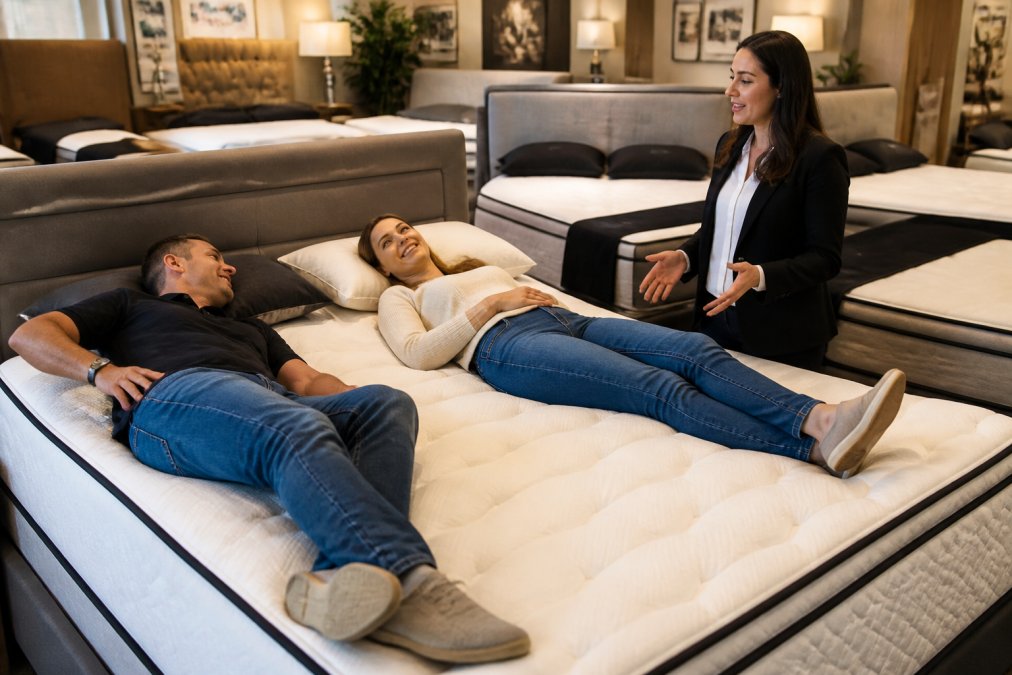
In-Store Testing Tips
- Wear loose clothing and remove your shoes.
- Lie in your normal sleep position, not on your back if you are a side sleeper.
- Slide a hand under your lower back. A small gap is fine; a big one means the bed is too firm.
- Check the edge by sitting on it. Weak edges shorten the mattress's usable life.
- Spend at least ten minutes. Bring your pillow if you can.
Durability, Trial Periods, and Warranty Coverage
A mattress is a long-term purchase, so durability and warranty coverage matter as much as feel. Most quality mattresses last eight to ten years, and how you care for yours affects that number. But the fine print on trials and warranties is where back-pain shoppers get burned, so read it before you buy.
Sleep Trials and Return Policies
A sleep trial lets you test the bed at home, usually for a set number of nights. What matters more than the length is the structure:
- Minimum break-in period. Most brands require you to sleep on the mattress for at least 30 nights before you can return it. This exists because foam and coil units soften measurably in the first month, and a bed that feels too firm on night three often feels right by night 30. If your back pain is severe, a 30-night minimum is a real cost, you are committing to a month of potentially worse sleep.
- Return fees.
- Who pays return shipping. For online brands, the brand usually arranges pickup. For in-store purchases, ask whether the store picks up or whether you have to haul it back.
- Foundation compatibility. This is the clause that voids the most warranties. Most manufacturers require a solid platform, an adjustable base, or a box foundation with slats no more than a few inches apart. Put a mattress on a sagging box spring or a slatted frame with wide gaps and you have voided your coverage before the sag even starts.
Materials That Prevent Sagging
Sagging is the number one killer of back support. A mattress that develops a visible body impression loses the lumbar support it was bought for, and the impression usually shows up right where the heaviest part of the body rests.
What actually resists sag:
- High-density foam. Support cores should be at least 1.8 lb per cubic foot; premium builds run 2.0-2.5 lb. Low-density foam (under 1.5 lb) collapses within a few years, and no warranty will cover it unless the impression exceeds the brand's threshold.
- Coil count and gauge in hybrids. A higher coil count spreads load across more points, which slows compression. Thicker-gauge coils resist bending better under heavier sleepers.
- Edge support. A reinforced perimeter keeps the usable sleep surface from collapsing at the sides, which matters if you sit on the edge to get in and out of bed or sleep near the edge.
- A supportive foundation. Even a great mattress sags prematurely on a weak base. Slats should be close together and the center should be supported on queen and king sizes.
Warranty Coverage: What Is Actually Covered
A few things to check:
- Impression threshold.
- What voids coverage. Stains (use a waterproof protector), improper foundation, removing the law tag, and buying from an unauthorized seller are the most common disqualifiers.
- Who pays shipping on a warranty replacement. Often the customer. Ask before you buy.
Rotate your mattress every three to six months (most hybrids and foams are not flippable), use a protective cover to keep materials dry, and keep the receipt and law tag. Those three habits do more for longevity than any add-on.
Frequently Asked Questions
What type of mattress is best for people with back pain?
Medium-firm mattresses with high-density foam or latex often work best because they support spinal alignment while relieving pressure. Hybrids combine coils for edge support with foam for contouring. Side sleepers may prefer softer options, while back and stomach sleepers typically need firmer surfaces. Testing in person at a local showroom helps you feel how a mattress responds to your body.
Is a firm or soft mattress better for back pain?
Medium-firm is the most recommended firmness for back pain. A mattress that is too firm can create pressure points at the shoulders and hips, while one that is too soft allows the spine to sag. Look for a mattress that keeps your spine in a neutral position and provides lumbar support without feeling hard. Your weight and sleeping position also affect which firmness works best.
How often should you replace your mattress to prevent back pain?
Most mattresses last 7 to 10 years. Replace yours sooner if you notice sagging, visible indentations, or if you wake up with chronic discomfort. A worn mattress loses its ability to support spinal alignment, which can worsen back pain. High-density foam and quality coil systems hold up longer. Check warranty coverage for specific durability guarantees.
Do adjustable bases really help with back pain?
Adjustable bases can ease back pain by elevating your head or legs to reduce pressure on the spine. Raising the head helps with acid reflux and breathing, while elevating the legs improves circulation and reduces lower back strain. Many adjustable bases offer zero-gravity positions that distribute weight evenly. They work with most memory foam, latex, and hybrid mattresses.