 how-to
Benefits of Testing Mattresses in Store: A 2026 Guide
Table of Contents
- Why the Benefits of Testing Mattresses in Store Matter More Than Ever
- How to Test a Mattress in Store: A Repeatable, Timed Protocol
- How Long to Test a Mattress in Store Before You Commit
- What to Look for When Buying a Mattress: Support, Comfort, and the Details That Decide It
- In-Store vs. Online Mattress Shopping: What Each One Gets Right
- Testing With a Sleep Partner, Accessibility Needs, and Showroom Etiquette
- Bring a Comparison Worksheet and Ask the Right Questions
- Conclusion
- Frequently Asked Questions
Last Updated: October 19, 2026
Why the Benefits of Testing Mattresses in Store Matter More Than Ever
A mattress is one of the few purchases you make with your whole body, every night, for years. At Cannon's Fine Home Furnishings, we've watched that gamble play out in returns, exchanges, and a lot of restless nights.
Online shopping has its place. But when it comes to sleep, physical testing closes a gap that no return policy fully covers.
Here's what most guides get wrong: they tell you to "lie down for a few minutes." That's not a test. That's a nap. A real test has a method.
How to Test a Mattress in Store: A Repeatable, Timed Protocol
Testing mattresses is a skill, not a vibe check. The goal is to compare beds under the same conditions so your decision rests on evidence, not on which showroom felt cozier.
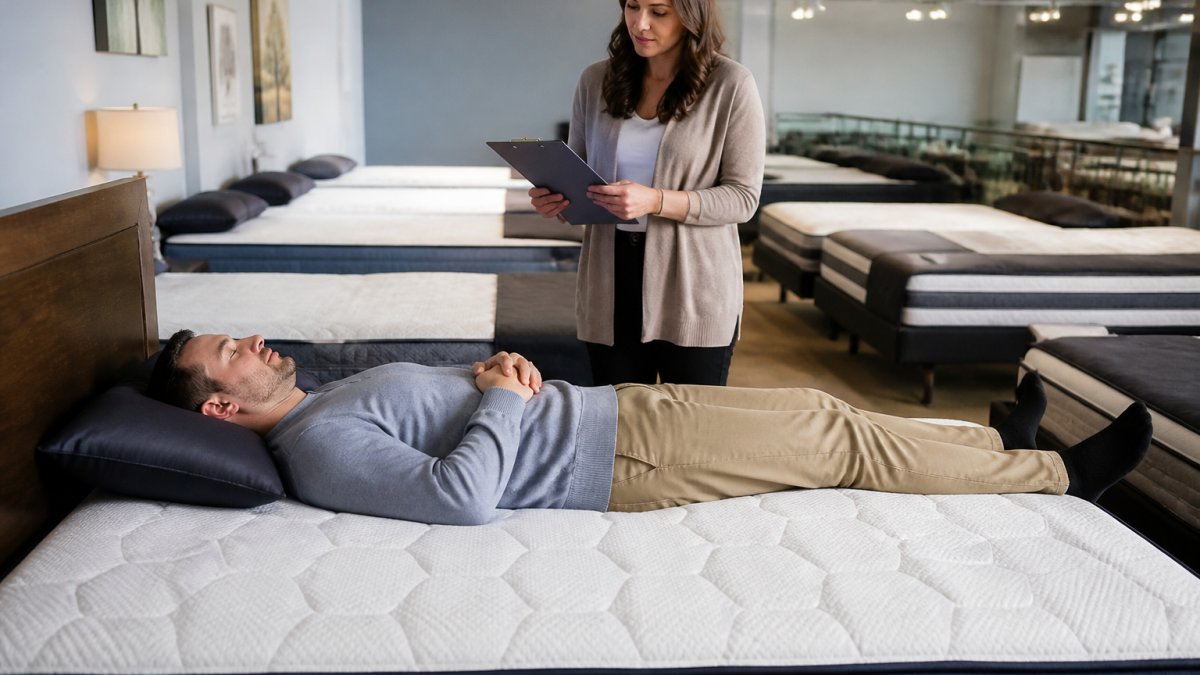
Step 1: Dress for the Test
Wear loose clothing and shoes you can slip off. Bring the pillow you actually sleep on if you can. Small details like these change how a mattress feels, and you want your test to match your real bedroom.
Step 2: Run the 15-Minute Rotation
Spend at least 15 minutes on each mattress you're serious about. Rotate through these positions:
- Back sleeping: 5 minutes. Check whether your lower back feels supported, not arched.
- Side sleeping: 5 minutes. Your spine should stay straight from head to hip.
- Stomach sleeping: 2 minutes. Watch for sinking hips or a strained neck.
- Sitting and edge: 3 minutes. Sit on the edge, then lie near it to judge edge support.
Repeat the same rotation on every bed. Same order, same timing. That's how you compare mattresses fairly.
How Long to Test a Mattress in Store Before You Commit
Plan for at least 15 minutes per mattress, and 45 to 60 minutes total if you're comparing three or more.
Quick lie-downs favor whatever feels softest in the moment. That's rarely the bed you'll love in month six. Give each serious contender enough time for pressure points to show up, especially in your shoulders and hips.
If a sales associate hovers, that's fine. Ask them to check back in 15 minutes. A good store, including ours, lets you browse at your own pace.
What to Look for When Buying a Mattress: Support, Comfort, and the Details That Decide It
What to look for when buying a mattress comes down to three things: how your spine lines up, how your pressure points feel, and how the bed handles movement and edges. Firmness is a starting filter, not the whole story. The difference between a good test and a wasted afternoon is knowing what each check is actually measuring.
Pressure Relief and Spinal Alignment
Lie on your back and slide a hand under your lower back. A good mattress fills that gap without pressing hard.
Here is the mechanism behind the check: your shoulders and hips are the heaviest, narrowest points, so they sink first. If the mattress is too firm, those points take the load and you feel pressure. If it is too soft, your midsection sinks and your lower back arches.
Motion Isolation and Edge Support
If you share a bed, test motion isolation by having your partner roll over while you lie still. Foam and hybrid mattresses tend to absorb movement well; traditional innerspring beds transfer more of it. Then sit on the edge.
A concrete way to score both: rate motion transfer as low, medium, or high after your partner rolls from one side to the other three times.
Firmness, Materials, and What the Label Doesn't Tell You
Firmness is a starting filter. Most shoppers fall into one of three groups: side sleepers usually need softer surfaces to cushion shoulders and hips; back sleepers often do best on medium; stomach sleepers generally need firmer support to keep hips from sinking.
Materials matter because they drive how the bed feels over time. Memory foam contours and absorbs motion but can sleep warm; poly foam is lighter and bouncier; latex is resilient and responsive; innersprings add bounce and airflow; hybrids combine a coil core with foam comfort layers.
Translate the Showroom Feel to Home
A showroom bed has been tested by many shoppers and may feel more broken in than the new one delivered to you. Most mattresses soften slightly in the first few weeks. If a bed feels slightly firm in the store, that is often the safer bet for month six. Ask about the sleep trial and return policy before you buy, and confirm who pays shipping if you return it.
In-Store vs. Online Mattress Shopping: What Each One Gets Right
In-store vs. online mattress shopping isn't a contest with one winner. Each approach solves a different problem, and the smartest shoppers use both.
Online shopping wins on convenience and price transparency. You can read specs, compare mattress materials, and order from your couch.
In-store testing wins on certainty. You feel the foam, the coils, and the hybrid construction before you pay.
| Factor | In-Store Testing | Online Shopping |
|---|---|---|
| Feel before buying | Yes, full body test | No, rely on reviews |
| Compare side by side | Easy | Difficult |
| Ask questions live | Yes | Chat or email |
| Return hassle | Usually simpler | Shipping and fees |
| Best for | Sleep concerns, shared beds | Confident repeat buyers |
Testing With a Sleep Partner, Accessibility Needs, and Showroom Etiquette
Bring your partner. Sleep is shared, and a mattress that's perfect for one person can be misery for two. Take turns lying down, then test together to check motion isolation and space. A queen feels generous alone and snug with two adults and a dog.
A Partner-Testing Protocol
Test as a pair in this order so you compare fairly:
- Separate turns first. Each of you runs the 15-minute rotation alone while the other watches for alignment and pressure points. Note firmness scores independently before you discuss them.
- Together, still. Lie side by side in your normal positions for five minutes. Check whether you have enough room and whether the mattress dips toward the heavier sleeper.
- Motion test. One partner rolls over three times while the other lies still and rates motion transfer low, medium, or high. Repeat with the other partner moving.
- Edge test. Each partner sits on the edge, then lies near it. If one of you uses the edge to get in and out, weight this check heavily.
- Compare notes. If your firmness scores differ by more than one point, look for a model with a adjustable base or a split-king option, or keep testing.
Accessibility and Mobility Considerations
If getting in and out of bed is hard, test the height first. Sit on the edge with your feet flat on the floor. Your knees should be roughly at hip height, and you should be able to stand without pushing hard off the mattress.
Ask about adjustable bases, which let you raise the head and feet and can make getting up easier. For people with mobility limitations, an adjustable base can matter more than the mattress itself.
Showroom Etiquette and Hygiene
Showroom etiquette is simple: keep it clean, wear socks or bring shoe covers if asked, and don't eat on the beds. Ask for a clean pillow protector or bring your own pillow. If you have allergies, ask whether the store uses mattress protectors and how often display bedding is refreshed. A little courtesy keeps the showroom pleasant for everyone testing after you.
Test with the person you sleep beside, at the height you'll actually use, in the positions you actually sleep in. Anything less is a partial test.
Bring a Comparison Worksheet and Ask the Right Questions
A simple worksheet turns a blur of beds into a clear decision. Score each mattress as you go, then compare the notes at the end. This is the step most shoppers skip, and it's the one that saves the most regret.
Use a checklist like this for each mattress:
- Brand and model name
- Firmness (soft, medium, firm)
- Back position: comfortable for full 5 minutes? (1-5)
- Side position: spine straight, shoulders comfortable? (1-5)
- Edge support: firm or collapsing? (1-5)
- Motion transfer with partner: low, medium, high
- Sleep trial and return policy terms
- Warranty length and what it covers
- Delivery and setup included?
Then ask the sales associate these questions:
- What's the return policy, and who pays shipping if I return it?
- How long is the sleep trial, and does it start on delivery?
- What does the warranty cover, and what voids it?
- How does this bed hold up for side sleepers or heavier sleepers?
- Can I try an adjustable base with this mattress?
Write the answers down. Memory fades fast once you've tested six beds.
Ask how the in-store feel translates to home. A showroom bed has been broken in by other shoppers; a new one arrives firmer. Most mattresses soften a little in the first few weeks, so a bed that feels slightly firm in the store often settles into the right feel at home.
Conclusion
The challenge isn't finding a mattress. It's finding the one your body agrees with, and that takes more than a glance at a product page. Testing in store lets you feel support, check alignment, and compare options with your own body as the judge.
At Cannon's Fine Home Furnishings, we make that easy. Our 70,000-square-foot showroom lets you browse at your own pace, our team offers personalized guidance and dedicated support, and flexible financing plus professional in-home delivery and setup handle the rest.
Frequently Asked Questions
What are the benefits of testing mattresses in store?
Testing mattresses in store lets you feel firmness, support, and pressure relief before you spend money. You can compare foam, innerspring, and hybrid construction side by side, check edge support and motion isolation, and confirm the mattress size fits your room. You also get to ask a sales associate direct questions about warranty, return policy, and delivery. Physical testing catches mismatches that online reviews and spec sheets cannot show, which lowers the odds of a costly exchange later.
How long should you lie on a mattress before deciding?
Give each mattress at least 15 minutes, and spend closer to 20 to 30 minutes on the one you are serious about. Short 2-minute tests mostly measure first impressions, not how the mattress feels once your body settles. Rotate through your normal sleep positions during that time: side, back, and stomach. If you sleep with a partner, test together so you can judge motion transfer and whether the firmness works for both of you.
Can you tell if a mattress is right for you by lying on it in a store?
You can rule out mattresses that clearly do not work and narrow the field to two or three strong candidates. A store test shows firmness, contouring, pressure points, and edge support in a way no spec sheet can. What it cannot show is how the mattress breaks in over several weeks. That is why you should pair in-store testing with the store's sleep trial and return policy, so you have a path to adjust if the feel changes at home.
Is it better to buy a mattress in store or online?
It depends on what you value. Online shopping offers convenience and broad selection, but you cannot touch the product. In-store testing lets you compare mattresses in person, check construction and materials, and get help matching firmness to your sleep position. Many shoppers research online first, then test in a showroom before buying. That combination gives you the information of online research with the physical confirmation of a store visit, and a local team to call if delivery or setup goes wrong.