 comparison
Solid Wood vs Veneer Furniture Durability: 2026 Guide
Table of Contents
- Solid Wood vs Veneer Furniture Durability: Key Differences
- How to Tell If Furniture Is Wood Veneer
- Durability by Component: Where Each Material Holds Up
- Can Veneer Furniture Be Refinished? What You Need to Know
- Veneer Furniture Care and Maintenance for Everyday Use
- Best Wood for Durable Furniture: Oak, Hardwood, and Softwood Compared
- Moisture, Temperature, and Warping: Long-Term Performance
- Repairability and Lifecycle Cost: Solid Wood vs Veneer
- Frequently Asked Questions
Last Updated: October 6, 2026
Solid Wood vs Veneer Furniture Durability: Key Differences
Solid wood vs veneer furniture durability comes down to one structural fact: solid wood is the same material all the way through, while veneer furniture is a thin slice of real wood glued over a core of plywood, particleboard, or MDF. At Cannon's Fine Home Furnishings, we carry both constructions in our 70,000-square-foot showroom, and neither material wins everywhere.
Solid Wood: Through-and-Through Construction
Solid wood is lumber cut from a single tree, milled into boards and joined into tabletops, legs, and frames. Sand it, dent it, or scratch it, and you still have wood underneath, which is why solid wood furniture can be sanded and refinished repeatedly. The trade-offs: it moves with humidity, so wide tabletops expand and contract seasonally, and it costs more because you pay for full-thickness hardwood.
Veneer: A Thin Layer Over a Stable Core
Wood veneer is a thin slice of real wood, often less than a millimeter thick, bonded to a core panel of plywood, particleboard, or MDF. The veneer gives you genuine wood grain and color; the core gives you stability and a lower price. Well-made veneer furniture resists warping better than solid wood because the engineered core does not move the way a solid board does.
How to Tell If Furniture Is Wood Veneer
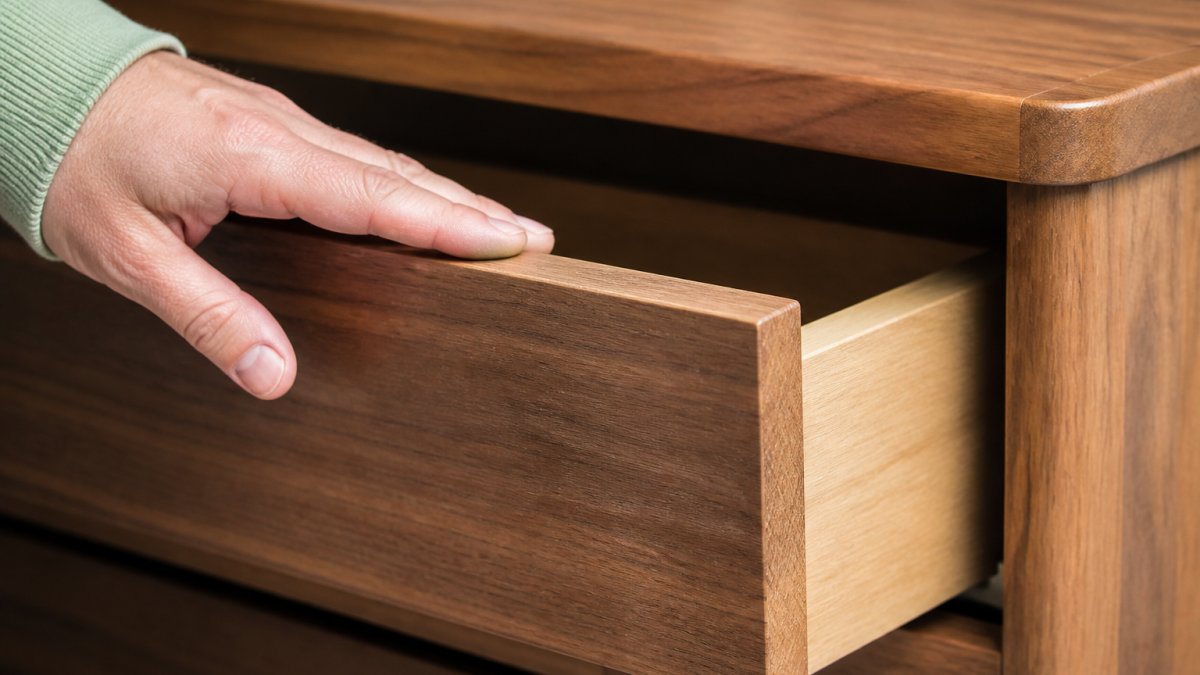
The fastest test is to look at the edges. On solid wood, the grain runs continuously from the top surface around to the side.
Three more checks to consider:
- Look at the underside. Solid wood shows the same grain on the bottom as the top. Veneer often shows a plain core panel underneath.
- Check the weight. A solid oak dining table is heavy. A veneer table of the same size feels noticeably lighter.
- Examine the grain pattern. Repeating grain across a large surface is a sign of printed or matched veneer, not solid lumber.
Durability by Component: Where Each Material Holds Up
Durability is not a whole-furniture property. A piece can have a solid wood frame and a veneer top, and each part ages differently.
| Component | Solid Wood | Veneer Furniture |
|---|---|---|
| Tabletops and desks | Resists dents, can be sanded | Scratches show, limited sanding |
| Legs and frames | Strong, holds joints well | Depends on core quality |
| Drawer fronts | Refinishable | Thin surface, prone to chipping |
| Large panels | Can warp seasonally | Stable, resists warping |
Tabletops and Desks: Scratch and Dent Resistance
Tabletops take the most abuse, and this is where solid wood pulls ahead. A solid oak or hardwood top can absorb a dent and still be sanded smooth years later.
That said, a quality protective finish matters more than the material underneath for day-to-day scratch resistance. A well-finished veneer table will outperform a poorly finished solid wood one.
Legs, Frames, and Joints: Strength and Stability
Frames and legs favor solid wood for one reason: joints. Screws, dowels, and mortise-and-tenon joints hold better in solid lumber than in particleboard, which can crumble under repeated stress.
If you are buying a veneer piece, check the frame material specifically. A solid wood frame under a veneer top is a genuinely good combination and often the smartest buy in the room.
Can Veneer Furniture Be Refinished? What You Need to Know
Most guides answer this with a flat "no." That is too blunt. Whether veneer can be refinished depends on how thick the veneer is, how much finish sits on top of it, and how deep the damage goes.
Veneer Thickness: The Number That Decides Everything
Wood veneer is sold and applied in a range of thicknesses wider than most shoppers expect:
- Paper-backed and thin commercial veneer: roughly 0.2 to 0.6 mm. Common on mass-market and flat-pack furniture. Almost no sanding margin.
- Standard furniture veneer: roughly 0.6 to 1.0 mm. Typical of mid-range case goods. A light scuff-sand is safe; anything deeper is risky.
- Thick or "thick-cut" veneer: roughly 1.0 to 2.0 mm or more. Found on better case goods and some custom work. Can tolerate careful sanding and spot repairs.
The veneer on a $300 dresser is often a fraction of the thickness of the veneer on a $3,000 one, even though both are described as "wood veneer" on the spec sheet. Thickness is rarely printed on the tag, so you have to infer it.
How to Estimate Veneer Thickness Before You Buy
You cannot measure veneer with a tape measure at the store, but you can read the signals:
- Look at an exposed edge. On a drawer front or table edge where the veneer wraps, a thicker veneer shows a visible wood lip above the core. A paper-thin veneer looks like a decal.
- Check the product spec. Terms like "thick-cut veneer," "5-ply," or a stated veneer species and cut (plain-sliced, rotary-cut) usually signal a better build. "Wood veneer over engineered wood" with no further detail usually signals thin.
- Press a fingernail near an edge. On thin veneer, you can feel the core through the surface. On thick veneer, the surface feels like solid wood.
- Look at the corners. Thin veneer chips at corners; thick veneer wears at corners. The wear pattern tells you the thickness.
What Repairs Are Actually Safe
Once you know roughly how thick the veneer is, the repair menu narrows:
| Damage | Thin veneer (under ~0.6 mm) | Standard veneer (~0.6-1.0 mm) | Thick veneer (1.0 mm+) |
|---|---|---|---|
| Dull finish, light scuffs | Clean and re-oil or wax; do not sand | Light scuff-sand with 320-grit, then recoat | Scuff-sand and recoat |
| Shallow scratches | Wax stick or color-matched filler | Wax stick, then a careful spot sand | Spot sand and recoat |
| Deep scratches, stains | Color-match and seal; sanding will cut through | Very careful local sanding with a block, then recoat | Local sanding and recoat |
| Lifted or bubbled veneer | Re-glue and clamp; do not sand | Re-glue and clamp; light sand after | Re-glue, clamp, sand, recoat |
| Missing veneer | Patch with matching veneer or accept the loss | Patch with matching veneer | Patch with matching veneer |
A few practical rules hold across all three thicknesses:
- Sand with the grain, by hand, with a block. Never use a belt sander or orbital sander on veneer. One pass too many cuts through the layer and exposes the particleboard or MDF core underneath, and that damage cannot be reversed.
- Test in a hidden spot first. The inside of a drawer side or the underside of a table edge is the right place to learn how the veneer responds before you touch the visible surface.
- Stop the moment you see core. If the color changes from wood grain to a uniform tan or gray, you have hit the core. Stop sanding immediately.
When Refinishing Is Not Worth It
If the veneer is paper-thin, the damage is deep, or the piece has multiple lifted sections, refinishing will cost more than the piece is worth. The practical options are color-matched touch-up, a protective topcoat to slow further wear, or replacement. This is where solid wood's repairability advantage is most visible: a solid oak top with the same damage can be sanded back to bare wood and refinished, often more than once over the life of the piece.
Veneer Furniture Care and Maintenance for Everyday Use
Veneer furniture care and maintenance is mostly about protecting the surface, because you cannot repair it the way you can solid wood. A few consistent habits keep veneer looking sharp for years.
- Use coasters and placemats. Heat and moisture are the two fastest ways to lift veneer.
- Wipe spills immediately. Standing water can seep into seams and loosen the bond.
- Dust with a soft, slightly damp cloth. Avoid abrasive cleaners and scrubbing pads.
Best Wood for Durable Furniture: Oak, Hardwood, and Softwood Compared
Oak and other hardwoods are the best choice for durable furniture because their density resists dents and wear. Hardwoods like oak, maple, and cherry handle daily use far better than softwoods such as pine, which dent more easily. That does not make softwood a bad buy: pine is lighter, less expensive, and perfectly serviceable for bedroom pieces that see gentler use.
| Wood Type | Density | Best For | Watch Out For |
|---|---|---|---|
| Oak | High | Dining tables, desks | Higher cost |
| Maple | High | Kitchen and dining | Can be heavy |
| Cherry | Medium-high | Bedroom, living room | Darkens over time |
| Pine | Low | Bedroom, accents | Dents easily |
Moisture, Temperature, and Warping: Long-Term Performance
Moisture and temperature affect solid wood and veneer furniture differently, and the difference shows up at the component level, not the whole-piece level. A table can have a solid wood base that moves seasonally and a veneer top that stays flat, or the reverse. Understanding which part does what is the key to predicting how a piece will age in a real home.
How Solid Wood Moves
Solid wood is hygroscopic: it absorbs and releases moisture from the air, expanding and contracting across the grain as humidity changes. A few practical numbers:
- Seasonal movement. A wide solid wood tabletop can move several millimeters across its width between a humid summer and a dry winter. The movement is across the grain, not along it.
- Humidity range. Most woodworkers aim to keep indoor relative humidity roughly between 35% and 55%. Below that, wood shrinks and can crack. Above that, it swells and can cup.
- Time to react. Solid wood responds to humidity changes over days to weeks, not hours. A single spill wiped up promptly is rarely a problem. A piece sitting in a damp basement for a season is.
In practice: a solid wood dining table may develop a slight gap at a seam in winter and close up in summer. That is normal movement, not a defect. A solid wood top left next to a heating vent can cup, crack, or check at the ends over time.
How Veneer Furniture Responds
Veneer furniture behaves differently because the core is engineered. Plywood, particleboard, and MDF are dimensionally more stable than solid lumber, so a veneer top resists warping better than a solid wood top of the same size. That is why veneer is common on large panels like sideboards and wardrobes. The weakness is the bond line: veneer is glued to the core, and that glue joint is the first thing to fail under repeated moisture exposure. The failure modes are predictable:
- Lifting at edges. Moisture seeps into an unsealed edge, swells the core slightly, and pushes the veneer up. This is the most common veneer failure.
- Bubbling in the field. A spill that sits on the surface can soften the glue under the veneer, creating a bubble that will not lie flat again without re-gluing.
- Peeling at seams. Where two veneer sheets meet, moisture can work into the seam and lift both edges.
Household Conditions That Actually Cause Damage
The abstract advice to "keep humidity steady" is less useful than knowing which specific conditions do the damage:
- Direct heat. A space heater, radiator, or fireplace within a few feet of a piece drives moisture out of solid wood and can dry out the veneer glue line. Keep at least a couple of feet of clearance.
- Direct sun. UV light fades and dries finishes on both materials. Solid wood can be sanded back; veneer usually cannot. Rotate pieces or use window treatments.
- Standing water. A spill wiped up within a few minutes is rarely a problem. A spill that sits overnight can lift veneer or stain solid wood.
Component-Level Performance Under Real Conditions
| Component | Solid Wood | Veneer Furniture |
|---|---|---|
| Wide tabletops | Moves seasonally; can cup or crack if humidity swings | Stable core resists warping; veneer can lift at edges |
| Legs and frames | Strong; joints tolerate movement | Depends on core; particleboard legs can crumble if wet |
| Drawer fronts | Refinishable if damaged | Thin surface; edges chip and lift |
| Large side panels | Can warp if unsupported | Most stable option; bond line is the weak point |
| Seams and joints | Movement can open seams | Seams can lift if moisture reaches them |
Prevention That Works for Both Materials
A short routine protects solid wood and veneer alike:
- Keep indoor humidity roughly between 35% and 55%. A hygrometer costs little and tells you more than guessing.
- Keep furniture at least a couple of feet from heat sources and out of direct sun.
- Wipe spills within minutes, not hours. Blot, do not scrub.
- Use coasters, placemats, and felt pads. Heat and moisture are the two fastest ways to damage either surface.
- Seal edges and undersides. Unsealed edges are where moisture gets in, especially on veneer.
- Reapply protective finish when the surface dulls. A fresh topcoat is far cheaper than a repair.
Repairability and Lifecycle Cost: Solid Wood vs Veneer
Repairability is where the two materials diverge most, and it shapes the true cost of ownership. Solid wood can be sanded, refinished, and repaired repeatedly, spreading its higher upfront price across decades of use.
Choosing between solid wood and veneer is really a question about how hard a piece will work in your home and how long you want it to last.
Frequently Asked Questions
Is solid wood furniture better than veneer?
Neither is universally better. Solid wood can be sanded and refinished multiple times, which extends its lifespan, but it costs more and can warp in humid conditions. Veneer furniture uses a thin layer of real wood over a stable core like plywood or particleboard, making it more affordable and resistant to warping. The best choice depends on your budget, the furniture's intended use, and how much maintenance you are willing to do.
Can veneer furniture be repaired if it gets scratched or chipped?
Minor scratches in veneer can sometimes be hidden with wood filler or touch-up markers. Chipped veneer is harder to repair because the thin layer cannot be sanded down without exposing the core. A furniture repair professional may be able to patch small areas, but large chips often require replacing the entire veneer sheet or the piece itself. Solid wood, by contrast, can be sanded and refinished to remove most surface damage.
How can you tell whether furniture is solid wood or veneer?
Look at the edges and underside of the piece. Solid wood shows continuous grain that wraps around corners and edges. Veneer often has a visible seam or edge banding where the thin layer meets the core, and the grain pattern may not match the underside. You can also check weight: solid wood pieces are noticeably heavier than veneer over particleboard. Tapping the surface can help too, as veneer may sound hollow.
How do you care for veneer furniture to make it last?
Keep veneer furniture away from direct heat and moisture. Use coasters under drinks and felt pads under lamps or decor. Dust with a soft, slightly damp cloth and avoid harsh chemicals or abrasive cleaners. Apply a furniture polish designed for veneer every few months to protect the finish. If you live in a humid area, run a dehumidifier to prevent the veneer from lifting or warping.